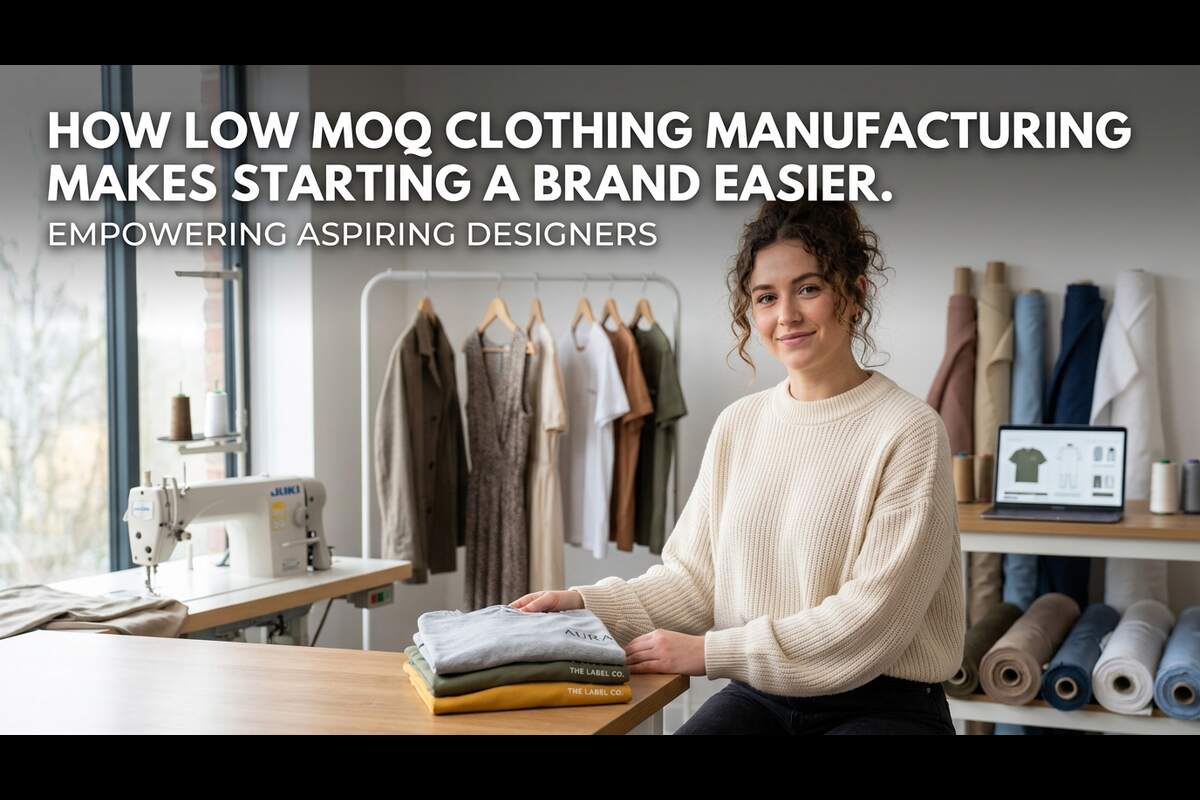
Starting a clothing brand can be exciting, but turning an idea into a profitable business requires careful decisions at almost every stage. Designers need to develop products, choose materials, establish pricing, create a recognizable identity, attract customers, and manage inventory without putting too much capital at risk.
For many new entrepreneurs, manufacturing is one of the biggest obstacles. Traditional production models can require large minimum order quantities, substantial upfront investments, and lengthy commitments before a brand has even proven that customers want its products. That can make launching a first collection unnecessarily expensive and risky.
Low-minimum-order-quantity manufacturing offers a more accessible alternative. Instead of requiring emerging brands to purchase thousands of units immediately, a flexible production partner can allow them to begin with smaller quantities, evaluate customer response, refine their products, and increase production as demand becomes more predictable.
This approach changes the economics of starting an apparel company. Entrepreneurs can move from concept to market with less inventory exposure while still developing professionally manufactured products. The result is a business model built around testing, learning, and controlled growth rather than making a large speculative investment at the beginning.
MOQ stands for minimum order quantity. It represents the smallest number of units a manufacturer is willing to produce for a particular order or product. In conventional apparel manufacturing, MOQs can be challenging for startups because factories may prioritize large-volume orders that make production more efficient.
A low MOQ model reduces that barrier. Instead of requiring a new brand to commit to a very large inventory run, the manufacturer accommodates smaller production quantities. The exact minimum varies according to the product, fabric, construction complexity, customization requirements, and manufacturing process.
The concept is particularly useful for first-time founders because their biggest challenge is often not production capacity. It is uncertainty.
A founder may believe a particular hoodie, jacket, shirt, or accessory will become a bestseller, but there is no guarantee customers will respond as expected. A smaller initial production run provides an opportunity to validate the concept in the real market before committing significantly more capital.
| Traditional Large MOQ Model | Low MOQ Model | Startup Advantage |
|---|---|---|
| Large initial inventory commitment | Smaller initial production run | Lower upfront financial exposure |
| Demand must be forecast far in advance | Products can be tested with customers | More informed production decisions |
| Greater risk of excess inventory | Inventory can be aligned more closely with demand | Reduced storage and markdown pressure |
| Changes may be expensive after production begins | Early batches can reveal improvement opportunities | Better product refinement |
| Growth may require a major upfront investment | Production can increase progressively | More controlled scaling |
Large order quantities can create several challenges for entrepreneurs who are still establishing their businesses. The most obvious issue is capital. Manufacturing hundreds or thousands of units requires money before the brand has generated corresponding sales revenue.
That initial investment may consume funds that could otherwise be used for website development, photography, packaging, advertising, influencer campaigns, fulfillment, or customer acquisition.
Inventory also creates an additional layer of risk. If a startup produces 2,000 units of a product and sells only a fraction of them, the remaining inventory does not simply disappear. It occupies storage space and ties up working capital. Eventually, the brand may have to discount the products to move them.
Large MOQs can also make experimentation difficult. A new brand may want to test several colors, silhouettes, materials, or design concepts. When every variation requires a large production commitment, experimentation becomes financially difficult.
Low MOQ production changes this equation by making experimentation more practical.
One of the greatest benefits of producing smaller quantities is the ability to control downside risk. New brands rarely have perfect information about what customers will buy. Even experienced fashion companies can misjudge trends, colors, pricing, or consumer preferences.
A smaller production run allows entrepreneurs to test their assumptions.
For example, a startup could launch a limited collection with several carefully selected products instead of filling a warehouse with an extensive range. Sales performance can then reveal which designs deserve additional investment.
This creates a more data-driven approach to inventory planning. Rather than asking, "How many units do I think I can sell?" the entrepreneur can eventually ask, "How quickly did the first batch sell, and what does that tell me about the next production run?"
This distinction is important because fashion demand is difficult to predict with complete accuracy. Customer feedback, social media engagement, repeat purchases, website conversion rates, and sales velocity can all provide useful evidence that improves future decisions.
Low MOQ production works particularly well with a test-and-scale strategy. Instead of treating the first production run as a final answer, brands can view it as a commercial learning opportunity.
A useful process looks like this:
This approach helps transform manufacturing from a high-risk commitment into an iterative business process.
Product development is rarely a straight line. The first version of a product may look good on paper but reveal practical problems during sampling or customer use. Perhaps the fabric is too heavy, a pocket is positioned incorrectly, a zipper does not feel premium enough, or a garment's proportions need adjustment.
When brands are locked into very large production quantities, correcting these issues can become expensive.
Smaller runs make it easier to learn from real-world results. Entrepreneurs can use early customer feedback to make informed improvements before expanding production.
This is especially useful for startups that are still developing their product identity. The first collection does not necessarily need to be the final expression of the brand. It can become the foundation for a better second collection.
Over time, this iterative process can help businesses build stronger products and a more recognizable design language.
New clothing brands sometimes make the mistake of launching too many products at once. A large catalog may appear impressive, but it can spread limited startup capital across dozens of SKUs.
Every additional product introduces another combination of variables, including sizes, colors, fabrics, trims, labels, packaging requirements, and inventory quantities.
A focused collection is often easier to manage. A startup might begin with a small group of products that share a common aesthetic and customer profile. This creates a coherent brand presentation without requiring an enormous inventory commitment.
The strategy can also make marketing more effective. Rather than promoting dozens of unrelated items, the business can build campaigns around a recognizable collection or hero product.
Once demand becomes clearer, the brand can gradually expand its catalog.
Starting with clothing does not mean a brand has to remain limited to garments. Accessories can create additional revenue opportunities while expanding the brand's lifestyle positioning.
Bags are particularly useful because they can complement apparel without introducing traditional clothing fit considerations. A customer who may hesitate to purchase a jacket because of sizing can still purchase a branded bag that reflects the same aesthetic.
Canvas is especially versatile for brands seeking a tactile, durable appearance. The material can support minimalist designs, embroidered branding, printed graphics, contrasting trims, and other visual treatments.
Adding accessories also creates opportunities for product bundles. A brand might combine a seasonal garment with a matching cross-body bag or use accessories as lower-priced entry products for customers who are discovering the brand for the first time.
Tote bags are another product category that can fit naturally into a developing apparel business. Their broad functionality makes them suitable for work, shopping, travel, school, events, and everyday use.
Unlike fitted garments, tote bags do not require customers to choose between multiple body sizes. That makes the purchasing decision relatively straightforward.
For a startup, this simplicity can be commercially valuable. A well-designed tote can serve as both a functional product and a highly visible branding surface.
Brands exploring custom tote bags wholesale can develop designs that complement their apparel collections through coordinated colors, logos, graphics, materials, or finishing details.
The manufacturing specifications still matter. A premium tote should have appropriate fabric weight, reliable stitching, reinforced handles, durable closures where required, and construction suited to its intended load. These details can determine whether customers view the product as a disposable promotional item or a genuine part of the brand's product line.
Consumers increasingly expect products to solve practical problems. This is one reason lifestyle accessories can be an effective complement to fashion collections.
Work bags are a good example. Professionals, students, freelancers, and commuters often need to carry laptops, chargers, documents, notebooks, and personal items. A product that combines these practical requirements with a distinctive design can appeal to customers who value both functionality and appearance.
Successful laptop bags require thoughtful construction. Padding, compartment organization, handles, shoulder straps, zipper quality, lining materials, and reinforcement points all influence usability. When these features are integrated into a cohesive design, the product can become much more than an ordinary computer carrier.
Cash flow is one of the most important considerations for a new brand. Revenue can take time to build, while expenses often arrive immediately. Manufacturing, packaging, website development, photography, advertising, shipping, and software costs can accumulate before a business has established consistent sales.
Large inventory purchases can intensify this pressure.
Low MOQ production gives entrepreneurs an opportunity to spread manufacturing investment across multiple stages. Instead of committing a substantial amount of cash to inventory before demand is established, a business can allocate capital more progressively.
This does not eliminate manufacturing costs or business risk. However, it can make available capital more flexible.
For example, a founder might use an initial production budget to develop a small collection, reserve some funds for marketing, and retain working capital for fulfillment and operational expenses. If the initial products perform well, additional revenue can contribute toward the next production cycle.
This type of disciplined capital allocation can be particularly valuable during the early stages of a brand.
A low MOQ should never be interpreted as a reason to lower quality expectations. The objective is to reduce unnecessary inventory risk while maintaining professional product standards.
Brands should still pay close attention to sampling, fabric specifications, construction, measurements, stitching, trims, labeling, and finishing.
| Quality Check | What to Review | Potential Problem if Ignored |
|---|---|---|
| Fabric | Weight, hand feel, durability, shrinkage, and color | Customer dissatisfaction or inconsistent production |
| Measurements | Garment dimensions and size tolerances | Fit problems and increased returns |
| Stitching | Seam strength, thread consistency, and finishing | Premature product failure |
| Hardware | Zippers, snaps, buckles, and other components | Functional failures and poor perceived quality |
| Branding | Labels, embroidery, printing, tags, and placement | Inconsistent brand presentation |
A reliable manufacturing workflow should include sample approval before bulk production. This allows the brand to identify issues while changes are still manageable.
Not every manufacturer offering smaller order quantities will necessarily be suitable for a growing apparel company. Brands should evaluate the complete production relationship rather than focusing exclusively on the minimum order number.
Important considerations include:
The final point is particularly important. A manufacturer may be an excellent fit for a startup's first 100 or 200 units, but the relationship should ideally have room to evolve. Once a product becomes successful, the brand needs a partner capable of supporting increased quantities without sacrificing quality or reliability.
Low MOQ should not be viewed solely as a permanent manufacturing model. It can be the first stage of a broader scaling strategy.
As sales become more predictable, brands can gradually increase production quantities. Larger runs may create opportunities for improved unit economics, provided realistic demand forecasts support the additional inventory.
A practical scaling model might look like this:
This approach allows manufacturing volume to grow alongside the business instead of forcing the business to grow around a large inventory commitment.
Creativity is an important competitive advantage for independent apparel brands. Entrepreneurs often have distinctive ideas that larger companies may be too slow or too risk-averse to pursue.
Low MOQ production can support this creativity because it makes smaller experiments more commercially practical.
A brand could test an unconventional fabric, limited-edition colorway, collaborative graphic, seasonal design, or niche product concept without purchasing enormous quantities. If customers respond positively, the concept can be developed further.
If it does not perform, the financial consequences may be more manageable than they would have been under a large-volume production commitment.
This encourages a culture of experimentation. Instead of trying to make every product perfect based solely on assumptions, brands can create thoughtful products, put them in front of customers, gather evidence, and improve.
Although low MOQ manufacturing offers significant advantages, it is not automatically a guarantee of success. Entrepreneurs still need to manage production carefully.
One common mistake is producing too many different SKUs simply because smaller quantities are available. A lower MOQ can make experimentation easier, but excessive product variety can still complicate inventory management.
Another mistake is ignoring unit economics. Smaller production runs may sometimes carry higher per-unit costs than larger orders. Brands should calculate total landed costs, including manufacturing, packaging, shipping, duties where applicable, fulfillment, marketing, and other relevant expenses.
It is also important not to skip product testing. A small order is still an investment. Approving production without carefully reviewing samples can create quality problems that damage the brand's reputation.
Finally, startups should avoid treating low MOQ as an excuse to operate without a long-term plan. The best use of flexible manufacturing is to learn quickly and build toward sustainable scale.
Starting an apparel business has become more accessible in many respects, but competition remains intense. Customers have more choices, social media can accelerate trends, and established brands compete for attention across the same digital channels.
That makes operational flexibility increasingly important.
A startup that can test products, respond to customer feedback, manage inventory carefully, and replenish successful designs has an advantage over a business locked into rigid production cycles.
Manufacturing flexibility can also allow entrepreneurs to remain focused on their customers. Instead of spending most of their available capital on speculative inventory, founders can invest in building communities, improving their online stores, producing better content, and creating stronger customer experiences.
In this environment, low MOQ clothing manufacturer partnerships can give emerging brands the production flexibility they need to turn promising concepts into market-tested products while keeping early inventory commitments under greater control.
A low MOQ clothing manufacturer is a production partner that accepts smaller minimum order quantities than manufacturers focused primarily on large-volume production. This can make apparel manufacturing more accessible to startups and emerging brands.
It can reduce upfront inventory exposure and make it easier to test products before committing to larger production quantities. Brands can use early sales and customer feedback to inform future manufacturing decisions.
Not necessarily. Order quantity and product quality are separate considerations. Brands should still evaluate materials, construction, sampling, quality control, and manufacturing standards before placing an order.
Yes. Depending on the manufacturer's capabilities, startups can develop complementary products such as cross-body bags, tote bags, laptop bags, and other accessories alongside their apparel collections.
Brands can monitor sales performance, identify successful products, improve designs based on customer feedback, and progressively increase order quantities as demand becomes more predictable.
Launching a clothing brand does not have to begin with a massive inventory commitment. Low MOQ manufacturing gives entrepreneurs a more flexible path from idea to market by allowing them to produce manageable quantities, validate customer demand, improve their products, and make better-informed decisions about future production.
The most successful strategy is not simply to manufacture as little as possible. It is to manufacture intelligently. A focused initial collection, strong quality standards, disciplined cash-flow management, careful customer research, and a reliable production relationship can give an emerging brand the foundation it needs to grow.
For entrepreneurs ready to turn an apparel concept into a commercially viable brand, the right manufacturing strategy can make the journey considerably more manageable. Start with products customers genuinely need, learn from every production cycle, and build your inventory around proven demand rather than assumptions.

This post has been authored and published by one of our premium contributors, who are experts in their fields. They bring high-quality, well-researched content that adds significant value to our platform.










London Lifestyle is your guide to fashion, travel, food, and modern city living in London. Stay inspired with daily lifestyle updates and trends.